Training
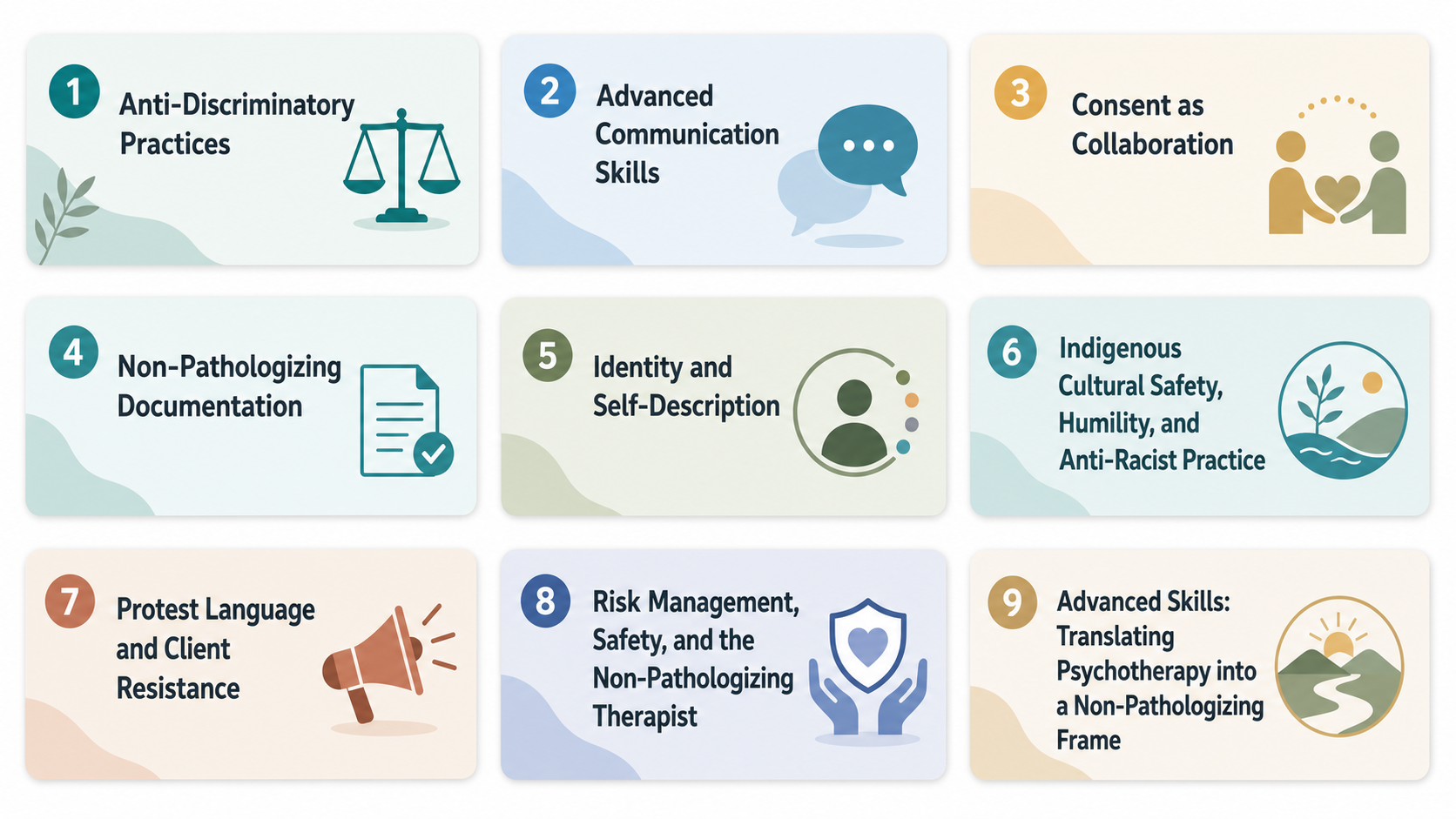 Advanced Skill Development in Non-Pathologizing through a series of 3 hour workshops
Each workshop is 3 hours long. They are online (Zoom) and begin at 9am (PST). Once you register and pay for the workshop you will be sent the material for the workshop. You register and pay through my Janeapp booking system.
Each workshop is $105 (GST included). Each workshop is limited to the first 15 people:
1. Translating Psychotherapy Into a Non-Pathologizing Frame (September 10, 2026)
Details: Most psychotherapists hold deeply non-pathologizing values inside the therapy room. Yet when they finish a session and sit down to write their notes, set a treatment goal, or reach for a clinical intervention, the inherited structures of the medical model quietly reassert themselves. The result is a gap that damages the integrity of the work: a therapist may ask collaborative, meaning-centred questions in session, then write about the client as avoidant, maladaptive, resistant, or non-compliant. This workshop closes that gap. The emphasis is not on learning a new modality — it is on translating the work therapists already do into a non-pathologizing frame that holds across session practice, documentation, case formulation, and consultation.
2. Listening for the Client's Protest Language (September 24, 2026)
Details: Every client who describes their suffering is simultaneously saying no — to the exhaustion, to the version of themselves they have been forced to become, to a life they never consented to live. Most therapeutic training teaches clinicians to treat that suffering as symptom data. This workshop teaches something fundamentally different: how to hear suffering as protest, and protest as agency. The shift is not in how clients present — it is in how therapists learn to listen. When the clinician stops defaulting to pathology, what had been called resistance becomes visible as protest, and protest becomes visible as the leading edge of the client's preferred narrative and preferred identity.
This is a practical, skills-intensive workshop. The goal is not theoretical agreement with non-pathologizing principles — it is a usable listening practice that therapists can take into sessions the following day. The workshop moves through conceptual foundations, a step-by-step clinical methodology, extended annotated scenarios, paired and group practice with live transcripts, and a framework for extending protest language listening into case formulation, documentation, and supervision.
3. Non-Pathologizing Documentation (October 5, 2026)
Details: Every clinical file tells a story — and most therapists were trained to tell the wrong one. The standard documentation culture of psychotherapy is built on the medical model: deficit-forward, therapist-centred, and organized around symptom management, compliance, and pathological interpretation. This workshop challenges that culture at its root, demonstrating that rigorous, legally defensible clinical records and genuinely humane, non-pathologizing documentation are not in tension — they are the same thing done well.
Designed for practising psychotherapists, this is a hands-on skills workshop. It moves from regulatory foundations through philosophical reorientation, and then into intensive practical translation exercises. Participants will leave with revised templates, concrete language alternatives, a clear framework for understanding assessment scope, and the CORE model as a working tool for clinical notes, treatment plans, case presentations, and therapeutic letters.
4. Identity (October 22, 2026)
Details: Every client who walks into a therapist's office carries layers of identity — some chosen, many imposed. When therapy relies on a diagnostic frame, those imposed layers are often deepened: the client who came looking for themselves leaves with a new label that becomes a new cage. This workshop inverts that dynamic. Rather than asking what is wrong with this person, it trains psychotherapists to ask: Who is this person, how have they been spoken about, and how do they want to be known?
Built from the Protest Language textbook and grounded in the Canadian regulatory and cultural landscape, this is both a theoretical and applied workshop. It moves through philosophy, neurodevelopmental theory, narrative practice, intersectionality, decolonizing frameworks, and intensive skills exercises — offering practitioners a coherent architecture for identity work that is clinical, ethical, and genuinely non-pathologizing.
5. Communication in Non-Pathologizing Psychotherapy (November 5, 2026)
Details: Language is the medium of psychotherapy — and it is never neutral. This workshop proceeds from the conviction that every word choice, every pause, every nod, and every question carries relational weight that either opens or forecloses the client's capacity for self-authored meaning-making. Communication is therefore not merely a professional skill to be refined; it is the primary site where pathologizing harm enters the therapeutic relationship, and the primary site where a non-pathologizing stance is enacted or abandoned.
This advanced skills workshop is designed for practising psychotherapists who wish to move beyond foundational communication training into a critical, linguistically informed examination of how they actually speak — and what their speaking does to clients. It is grounded in my Protest Language framework, informed by Thomas Gordon's foundational taxonomy of communication roadblocks, and developed through my research around three areas of communication: the study of communication manipulators, the clinical handling of client contradictions, and the structural problem of the tautology.
The CHCPBC Ethics and Practice Standards require that therapists communicate in a manner that is "not discriminatory, intimidating, coercive, or reflective of implicit or explicit bias," that they adapt their style to the client's needs and power dynamics, and that they support informed decision-making through language that is honest, accurate, and non-misleading. This workshop operationalizes those requirements at the micro-level — in the moment-to-moment texture of clinical conversation.
6. Anti-Discriminatory Practices in Psychotherapy (November 16, 2026)
Details: Discrimination in psychotherapy is rarely overt. It is more often embedded in the language we use, the frameworks we apply, the conclusions we hold before the client has spoken, and the systems we uncritically reproduce in the consulting room. This workshop begins with that premise and builds toward a practice-level translation of anti-discriminatory principles into everyday psychotherapeutic work.
The CHCPBC Ethics and Practice Standards (effective April 1, 2026) establish that licensees must protect clients from harm and discrimination across all aspects of professional conduct — including the delivery of care, communication, documentation, and clinical decision-making. The Code of Ethics requires therapists to provide services without discrimination on any protected characteristic under the BC Human Rights Code, and to ensure that personal biases and power dynamics do not undermine the delivery of inclusive, culturally safe care. This workshop meets those mandatory requirements not as a compliance exercise, but through the deeper lens of my non-pathologizing framework: that the medical model itself is one of the most pervasive and least interrogated sources of discriminatory harm in psychotherapy.
Participants will be invited to understand discrimination not just as a personal act, but as a systemic one — reproduced through diagnostic language, treatment planning structures, the moralization embedded in our most common modalities, and the very structure of the clinical case note. Drawing on social constructionism, critical race theory, feminist theory, and the concept of intersectionality (following Kimberlé Crenshaw and Patricia Hill Collins), the workshop will explore how the medical model's presupposed categories of normative behaviour, healthy functioning, and therapeutic outcome are themselves forms of imposed cultural identity — and how psychotherapists carry and transmit these categories, often without awareness.
7. Consent as Collaboration (December 7, 2026)
Details: Every psychotherapist is familiar with informed consent as a procedural obligation — a form to be signed, a disclosure to be read, a box to be checked before the work begins. This workshop argues that this understanding of consent is not only ethically inadequate under the new CHCPBC Ethics and Practice Standards, but that it is fundamentally incompatible with a non-pathologizing philosophy of care. Informed consent, properly understood, is not a single event that happens before therapy starts. It is an ongoing relational act — a continuous invitation to the client to understand, question, agree, and refuse — that must be renewed every time the therapist introduces a new intervention, shifts modalities, or changes direction mid-session. Reframing consent through the protest language framework reveals something more: a client who does not freely and fully consent is already saying no. Learning to hear that no is not a compliance skill — it is the foundation of non-pathologizing clinical practice.
8. Indigenous Cultural Safety, Humility, and Anti-Racist Practice (January 7, 2027)
Details: The CHCPBC Indigenous Cultural Safety, Cultural Humility, and Anti-Racism Practice Standard is not a supplementary professional development recommendation — it is a mandatory ethical requirement, enshrined in the Health Professions and Occupations Act and effective across all regulated health professions in British Columbia as of April 1, 2026. For psychotherapists preparing for regulation under CHCPBC, this standard demands more than cultural sensitivity or diversity awareness training. It demands a structural reckoning with the ways psychotherapy itself — through its history, its medical model foundations, its diagnostic frameworks, and its clinical language — has functioned as a site of colonization. This workshop provides the theoretical foundation, the ethical grounding, and the practical clinical tools to meet this standard — and argues that the non-pathologizing framework is uniquely positioned to operationalize it, because Indigenous cultural safety and non-pathologizing psychotherapy share the same foundational commitments: that the client is the expert on their own life, that distress is always contextual and adaptive, that dominant narratives must be examined and not imposed, and that the therapist's first obligation is to honour the dignity of the person in front of them.
9. Risk Management, Safety, and the Non-Pathologizing Therapist (January 18, 2027)
Details: The CHCPBC Risk Management and Safety Practice Standard states clearly: the public can expect licensed healthcare professionals to maintain practice environments that are physically, psychologically, and culturally safe. This single opening sentence contains a tension that sits at the heart of a non-pathologizing philosophy of care — because the question of who defines safety, how safety is created, and what clinical authority the therapist has to impose safety on a client has never been more ethically complex. This workshop argues that the non-pathologizing framework does not resist the CHCPBC's risk and safety obligations — it is, in fact, the most clinically coherent way to fulfil them. Safety is not simply a standard to be met; it is the first and non-negotiable stage of all psychotherapeutic work. But what the profession has routinely misunderstood is that the therapist does not — and cannot — make a client safe. The therapist can only recognize, honour, and collaborate around the client's own mechanisms for achieving safety — mechanisms that the medical model has historically named as pathology.
Group Supervision:
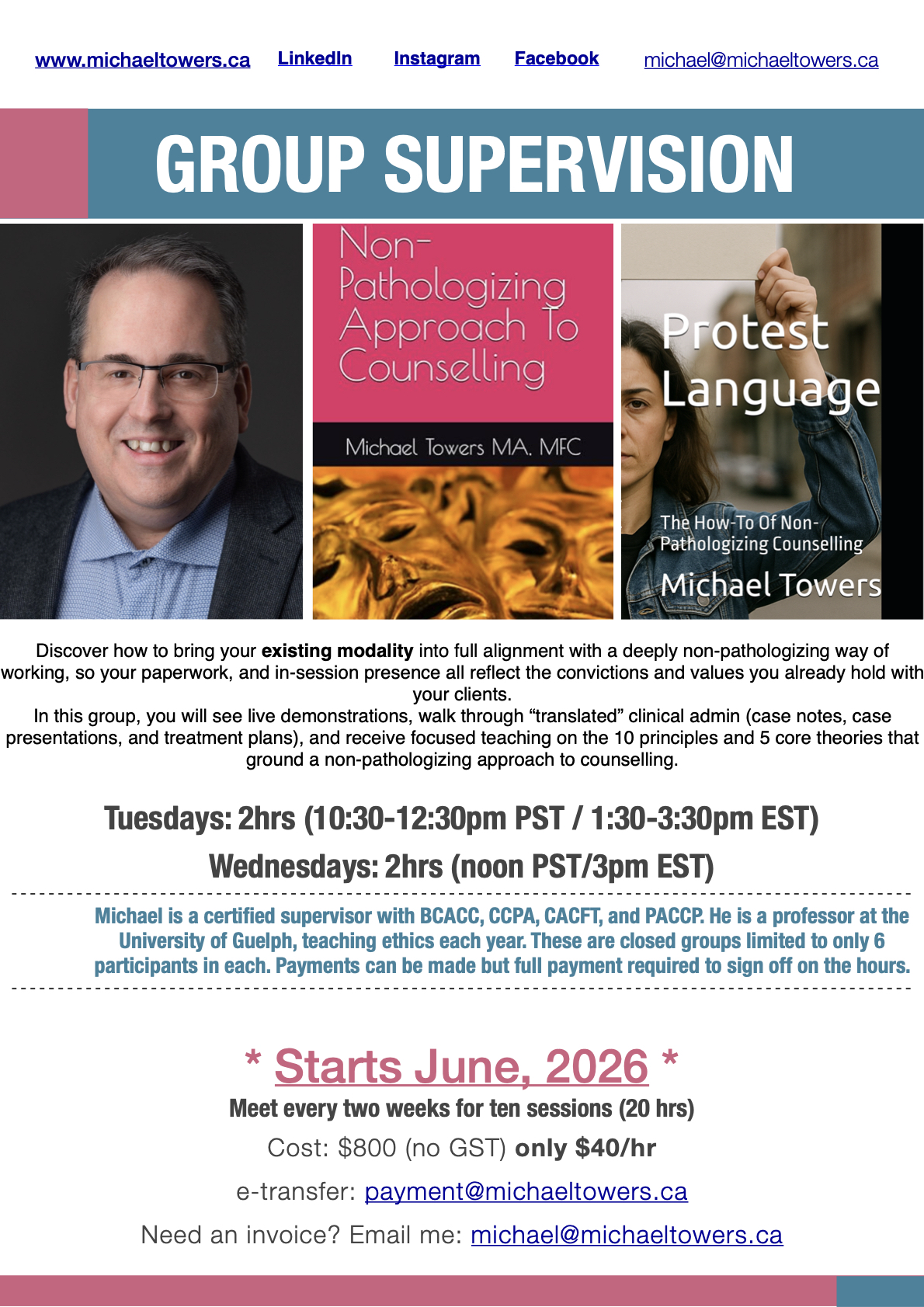
email: [email protected] to register for group supervision
Books
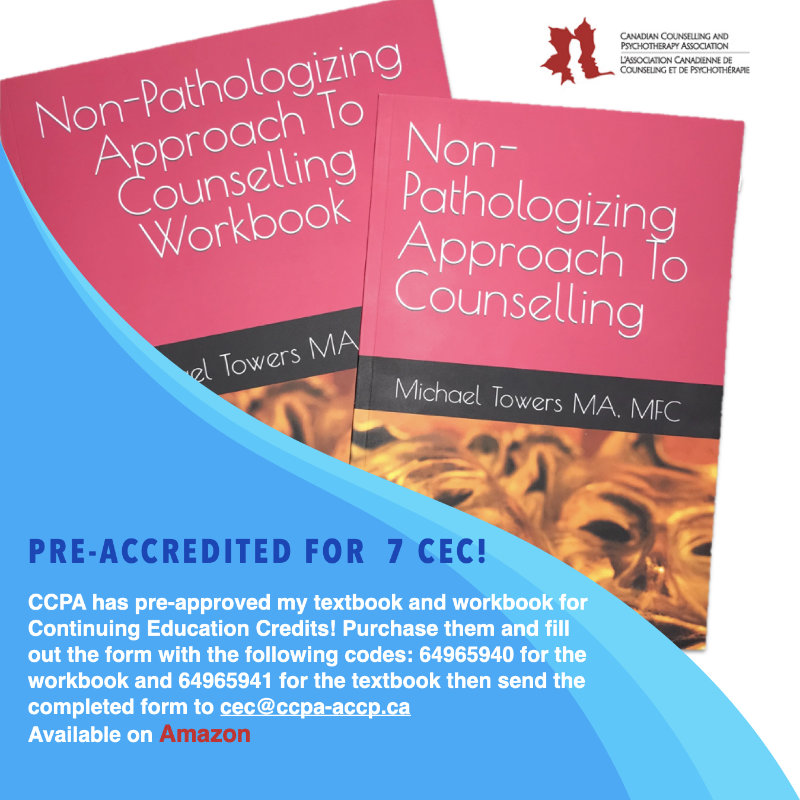
Non-Pathologizing Approach to Counselling
Non-Pathologizing Approach to Counselling Workbook
New Textbook (Published 2025)
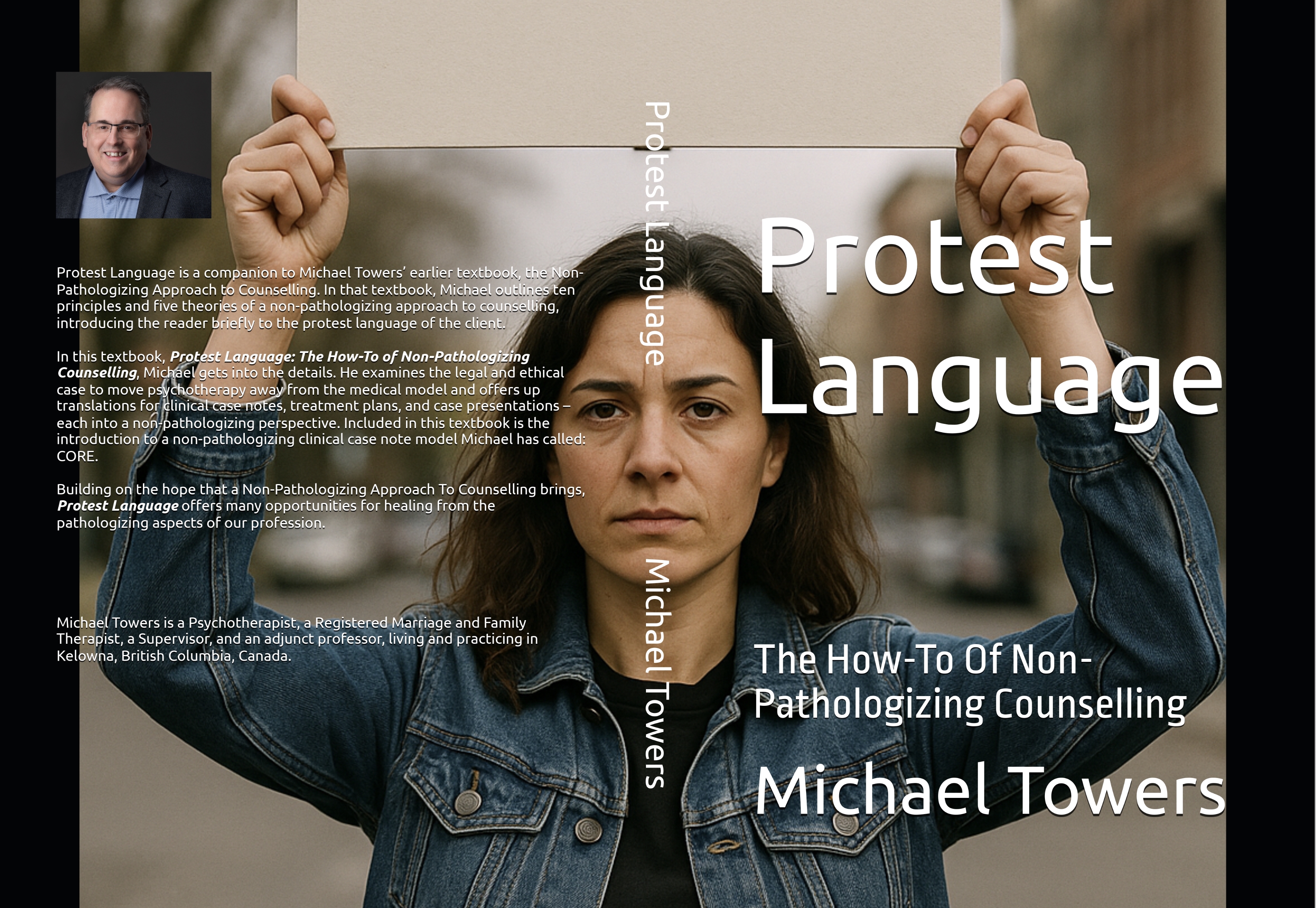
Link to textbook (preaccredited through CCPA for 8 CECs)
Audio version of the second edition of the textbook:
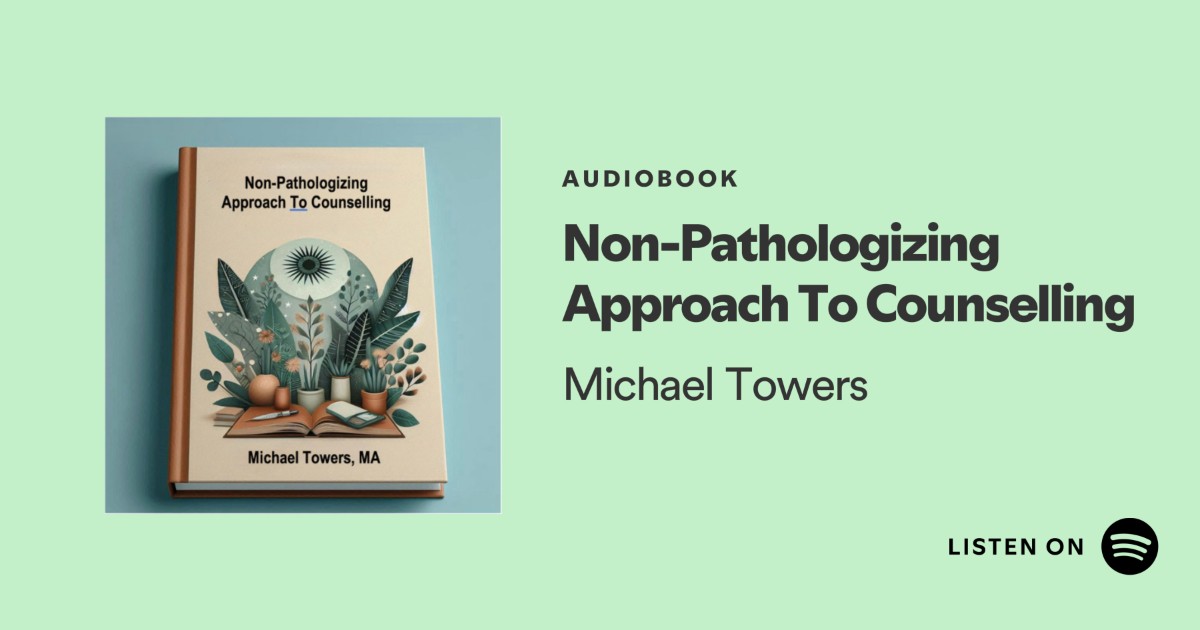
Spotify: https://open.spotify.com/show/5Ed08PJS4Wlqxv6npvEdg9
Kobo, Walmart: https://www.kobo.com/.../non-pathologizing-approach-to...
NOOK Audiobooks: https://www.barnesandnoble.com/.../non.../1144180952...
 Contact